How to Validate Client Ideas (For Agencies & Consultants)
Stop building apps for bad client ideas. Here's how agencies and consultants validate client concepts with data before wasting dev hours.
Last month a client wanted me to build "Uber for dog walkers." In a city with 40,000 people.
I could feel the problem. Market too small. No clear customer. Pricing that assumed people would pay $30 per walk when the neighbor's kid does it for $10.
But how do you tell someone their baby is ugly?
Most agencies don't. They take the project, bill the hours, and watch it die six months later. Then the client blames the build, not the idea.
There's a better way: validate first, build second. Let the data deliver the bad news.
The Agency Dilemma
You're not the founder. You don't have skin in the game. Your job is to execute, not to question.
Except execution without validation is expensive for everyone. And when it fails, guess who gets blamed?
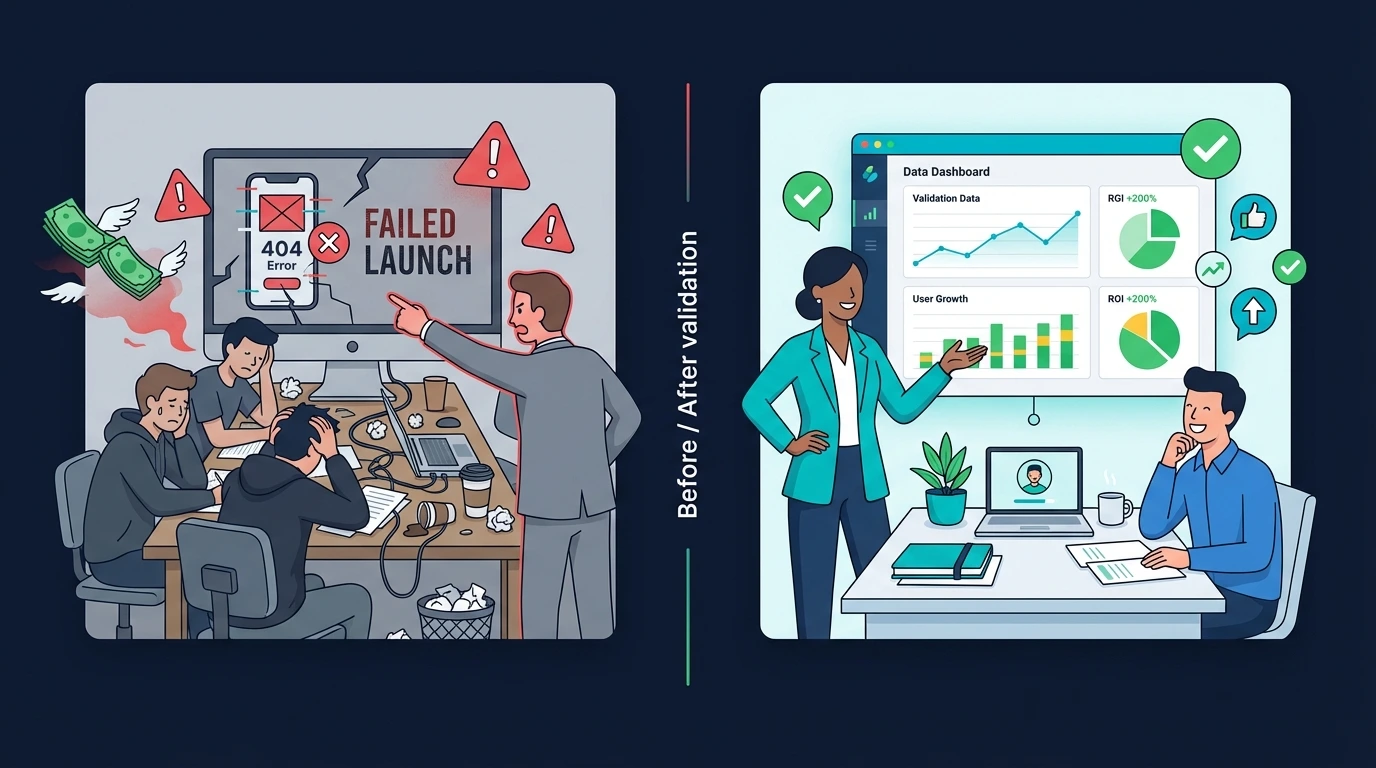
What happens when you skip validation:
- -3-6 months of development
- -$50K-200K in client spend
- -Launch to crickets
- -Client blames the build, not the idea
- -Relationship damaged, no referral
What happens when you validate first:
- ✓1-2 weeks of discovery
- ✓$2K-10K in validation services
- ✓Data-backed go/no-go decision
- ✓Client trusts your judgment
- ✓You either build something viable or save them from a mistake
The second path is better for everyone. Including your sanity.
Why Clients Come With Bad Ideas
Not their fault. They're excited. They've been thinking about this for months. But they fall into the same traps:
Solution-first thinking
"I want to build an app that does X." They've decided the solution before understanding the problem. Classic.
Audience of one
"I would use this, so others will too." Their personal pain isn't market demand. It's a sample size of one.
No competitor awareness
"Nobody's doing this." Translation: they Googled for 5 minutes. Or the market doesn't exist.
Fantasy pricing
"People will pay $99/month for this." Based on vibes and wishful thinking.
Your job is to pressure-test these assumptions before billing $150K in development. Before you're six months deep in something nobody wants.
The 5-Point Client Validation Framework
I use this for every new client project. Takes 1-2 weeks. Bill it as a discovery phase.
1. Problem Validation
Question: Is this a real problem people actively try to solve?
- •Search Reddit, Twitter, forums for complaints
- •Look for existing solutions (even bad ones)
- •Check Google Trends for search volume
- •Ask: "How do people solve this today?"
Red flag
No one is complaining about this problem online.
Green flag
Active discussions, frustrated users, people paying for workarounds.
2. Market Validation
Question: Is the market big enough to matter?
- •Count potential customers (LinkedIn, Census data, industry reports)
- •Calculate TAM/SAM/SOM
- •Check if competitors have raised funding
- •Look for market growth signals
Red flag
TAM under $50M or declining market.
Green flag
$100M+ SAM, growing market, funded competitors.
3. Competitive Validation
Question: Who else is solving this, and can the client win?
- •List direct competitors (same solution, same customer)
- •List indirect competitors (different solution, same problem)
- •Analyze pricing, features, reviews, funding
- •Identify gaps the client could own
Red flag
10+ well-funded competitors with no clear differentiation.
Green flag
3-5 competitors with obvious weaknesses or gaps.
4. Customer Validation
Question: Will the target customer actually pay?
- •Define the ICP (Ideal Customer Profile) precisely
- •Find 5-10 real prospects matching the ICP
- •Interview them (or have the client interview them)
- •Ask about current spending, pain intensity, switching costs
Red flag
Prospects say "nice to have" or "maybe someday."
Green flag
Prospects say "I'd pay for that today" or "how much?"
5. Economics Validation
Question: Do the unit economics make sense?
- •Estimate customer acquisition cost (CAC)
- •Estimate lifetime value (LTV)
- •Check if LTV > 3x CAC
- •Model path to profitability
Red flag
Requires millions of users at $5/month to break even.
Green flag
500 customers at $200/month hits profitability.
How to Present Validation to Clients
The delivery matters as much as the data.
Don't say
"Your idea is bad."
Do say
"The data suggests some risks we should address before building."
Structure your validation report:
EXECUTIVE SUMMARY - Overall assessment (Go / Conditional Go / No Go) - Top 3 risks - Top 3 opportunities MARKET ANALYSIS - TAM / SAM / SOM with calculations - Comparable companies and their funding COMPETITIVE LANDSCAPE - Direct competitors (with funding, pricing, reviews) - White space opportunities RECOMMENDATION - Build as-is / Pivot / Don't build - If pivot: suggested direction - If build: suggested MVP scope
This positions you as a strategic partner. Not a code monkey who builds whatever someone asks.
Pricing Validation Services
This isn't a freebie you throw in. It's a standalone offering. Price it like one.
| Service | Price Range | Deliverable |
|---|---|---|
| Quick Scan | $500-1,500 | 2-page summary, 48h turnaround |
| Full Validation | $3,000-7,500 | Complete report, 1-2 weeks |
| Validation + Strategy | $7,500-15,000 | Report + GTM plan + MVP spec |
| Retainer | $2,000-5,000/mo | Ongoing validation for portfolio |
Here's the pitch I use:
"Before we scope the build, we do a 2-week validation sprint. It's $5,000 and tells us whether this idea has legs. If it does, we know exactly what to build. If it doesn't, we just saved you $100K. Either way, you win."
Most clients respect this. The ones who don't? They're the ones who'll blame you later anyway.
Automating Validation
Manual validation is thorough but slow. And slow means expensive.
What can be automated:
- •Competitor identification and funding data
- •Market size estimates (TAM/SAM/SOM)
- •Search volume and trend analysis
- •Reddit/Twitter sentiment scanning
- •Pricing benchmarks
What still needs humans:
- •Customer interviews
- •Strategic interpretation
- •Differentiation recommendations
- •Go/no-go judgment calls
The best approach is hybrid: automate the data gathering, spend your time on analysis and recommendations. That's where clients actually pay for your brain.
Automate your validation research
Get automated validation data →When to Say No to a Project
Some ideas aren't worth saving. And some clients aren't worth the headache.
Walk away if:
- -Client refuses any validation ("just build what I asked")
- -Market is clearly too small (<$10M TAM)
- -20+ well-funded competitors with no angle
- -Client can't define the customer
- -Economics require miracle conversion rates
Here's the email I send:
"Based on our validation, we don't think this is the right time for a full build. Here's what we found [share report]. We'd recommend [alternative]. If you'd like to proceed anyway, we understand, but we wouldn't be the right partner for this one."
You'll lose some revenue. You'll save your reputation. And your sanity.
The ROI of Validation Services
For agencies, validation services are:
New revenue stream
$5K validation projects add up. 10 per year = $50K in high-margin work. And you're not doing any coding.
Client filter
Clients who pay for validation are serious. Clients who refuse are going to be trouble later anyway.
Trust builder
"They told us our first idea was risky, we pivoted, and it worked." That's a testimonial you can actually use.
Scope anchor
Validation defines what to build. Fewer "can we just add one more thing" emails. Cleaner projects.
Referral generator
"They didn't just build it, they helped us figure out what to build." That's how you stand out from every other dev shop.
Validation as a Service: Your Offering
Here's how I package it. Steal this:
IDEA VALIDATION SPRINT What you get: ✓ Market size analysis (TAM/SAM/SOM) ✓ Competitive landscape report ✓ Customer profile definition ✓ Unit economics model ✓ Go/No-Go recommendation ✓ 60-min strategy call Timeline: 2 weeks Investment: $5,000 Optional add-ons: + Customer interviews (5 calls): $2,500 + MVP specification: $3,000 + GTM strategy: $4,000
White-label data tools for the research, add your strategic layer on top.
Automate the research. Add your expertise.
Get validation data for client projects →Related guides:
Frequently Asked Questions
How do I tell a client their idea is bad?
You don't say "bad." You say "the data shows some risks" and let the numbers do the talking. Show them the competitor list. Show them the market size. Let the evidence deliver the bad news so you don't have to.
Should I charge for validation or bundle it?
Charge separately. Always. If you bundle it into the project cost, you only get paid if they proceed. Standalone validation means you get paid even when you recommend not building. Plus it filters out the "just build what I said" clients.
How long should validation take?
Quick scan: 2-3 days. Full validation: 1-2 weeks. Anything longer and you're burning margin. Automate the data gathering, spend your time on analysis and recommendations.
What if they want to build anyway?
Document your concerns in writing. If they insist, either decline or add a clause: "Client acknowledges validation findings and proceeds at their own risk." CYA. When it fails, you have the receipts.
How do I validate industries I don't know?
Focus on the signals that transfer: market size, competitor funding, search volume, Reddit complaints. You don't need to be a healthcare expert to count healthcare competitors or read their reviews. For deep domain stuff, have the client bring in an expert.
Can I white-label validation reports?
Yes. Use tools like TestYourIdea for the data, add your logo, your analysis, your recommendations. The data is the foundation. Your strategic layer is the value-add. Clients pay for your brain, not the raw numbers.
Automate Your Validation Research
Get competitor data, market sizing, and demand signals for client ideas in 60 seconds. White-label the reports with your branding.
Explore Agency Tools→