Is My Startup Idea Good? How to Know in 60 Seconds
Stop guessing if your startup idea is good. Here's a 60-second framework to know if you should build it or move on.
You've been thinking about this idea for weeks. Maybe months. It feels obvious. "Why hasn't anyone built this?"
You told your mom. She said it's brilliant. You told your friend. They said "dude, that's actually good."
But you're still not sure.
Here's the problem: your mom loves you. Your friend doesn't want to hurt your feelings. And your gut? Your gut is optimized to make you feel good, not to evaluate market conditions.
Good ideas look like bad ideas. Bad ideas look like good ideas. Airbnb sounded insane. Juicero sounded reasonable. The only way to know is to check the data.
Here's how to do it in 60 seconds.
The 5 Questions That Matter
Every startup idea lives or dies on five questions. Be brutal with yourself.
1. Is the problem real?
Not "would this be nice to have." Real means:
- •People are actively searching for solutions
- •They're complaining about it online
- •They're paying for bad alternatives
60-second check:
Google "[problem] reddit" or "[problem] sucks". Find frustrated people? Problem is real. Find silence? It's not. Nobody complains about problems that don't exist.
2. Is anyone else solving it?
No competitors is a bad sign. It means one of three things:
- •The market doesn't exist (most common)
- •Someone tried and the bodies are buried somewhere
- •You Googled for 5 minutes and gave up
5-15 competitors = good sign. Validated market with room to differentiate.
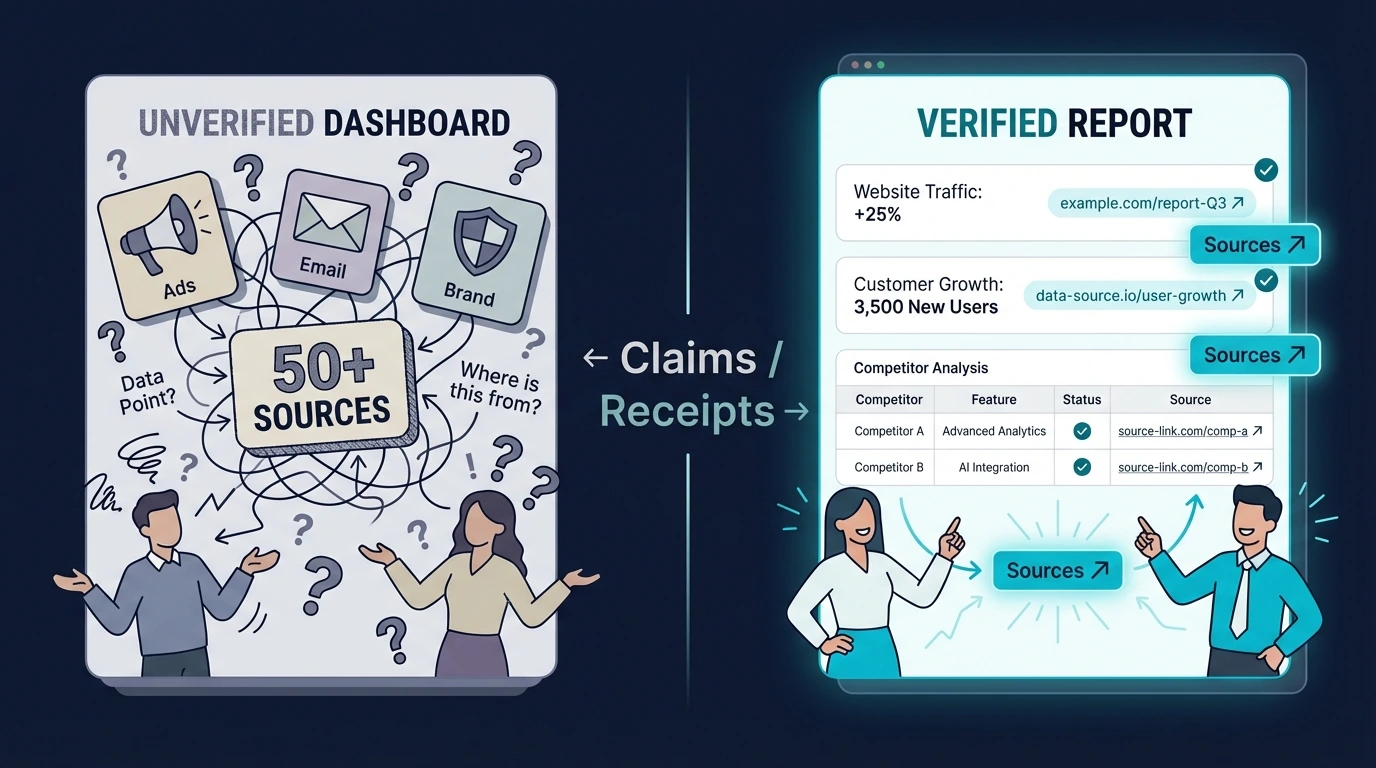
50+ competitors = red flag. Unless you have a very sharp angle, you're bringing a knife to a gunfight.
60-second check:
Google "[solution] + tool" or "[solution] + app". Count results on the first page.
3. Can you reach the customers?
The best idea in the world fails if you can't find buyers. Distribution kills more startups than bad products.
Ask yourself:
- •Where do these people hang out online?
- •Can you get in front of them without spending $10K on ads?
- •Do you have any unfair access? (Network, expertise, community)
60-second check:
Search for your target customer on Reddit, Twitter, LinkedIn. If you can find 100 of them in 60 seconds, distribution is possible. If you can't, it's not.
4. Will they pay enough?
Some problems aren't worth solving. Not because they're not real. Because the math doesn't work.
B2C app at $5/month = need 2,000 users for $10K MRR
B2B tool at $99/month = need 100 users for $10K MRR
Same revenue. 20x difference in difficulty.
60-second check:
Look at competitor pricing. That's your ceiling. Multiply by a realistic customer count. Does the number make you excited or depressed?
5. Why you? Why now?
Two founders with the exact same idea will have completely different outcomes. The idea isn't the variable. You are.
- •Do you have relevant expertise?
- •Do you have unfair distribution?
- •Is there a timing window? (New regulation, tech shift, cultural change)
60-second check:
If a Google engineer with $1M decided to build this tomorrow, would you still win? If you can't answer that, you don't have an edge.
The Quick Scorecard
Score each question 1-10:
| Question | Your Score |
|---|---|
| Problem is real and painful | /10 |
| Competition validates market (not saturated) | /10 |
| You can reach customers | /10 |
| Unit economics work | /10 |
| You have an edge | /10 |
Total 40+: Strong idea. Start validating deeper.
Total 25-39: Potential, but something's weak. Fix that thing.
Total under 25: Move on. Find a better idea.
What "Good" Actually Means
A good startup idea isn't:
- •Original (most good ideas are just better versions of existing things)
- •Clever (clever usually means complicated, which means hard to explain)
- •Exciting to other founders (they're not going to pay you)
A good startup idea is:
- •Solving a real problem people will pay to fix
- •In a market you can actually reach
- •With economics that make sense
- •And some reason you'll win
That's it. No magic. No secret sauce. Just math and timing.
The Fastest Way to Know
You can do all 5 questions manually. Google searches, Reddit stalking, competitor spreadsheets. It works. Takes a weekend.
Or you can get a data-backed answer in 60 seconds.
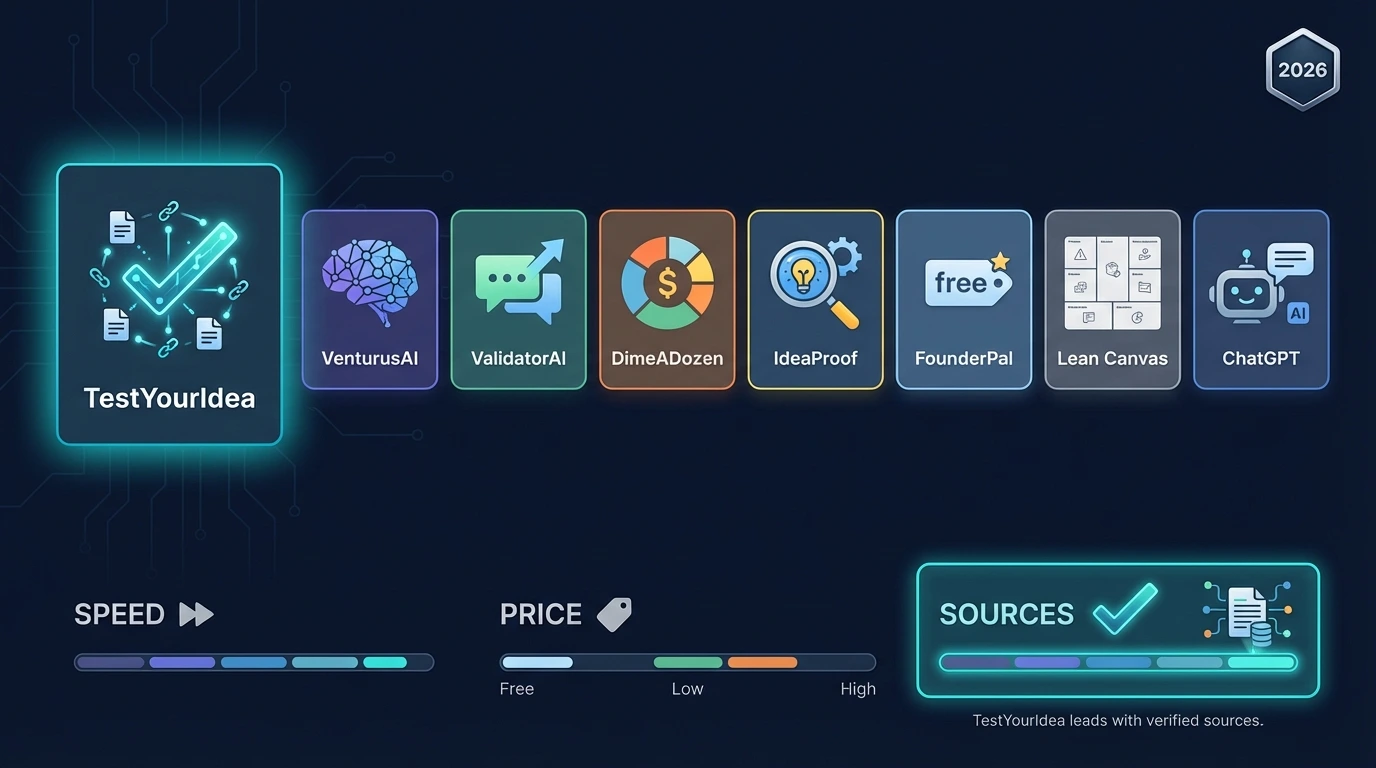
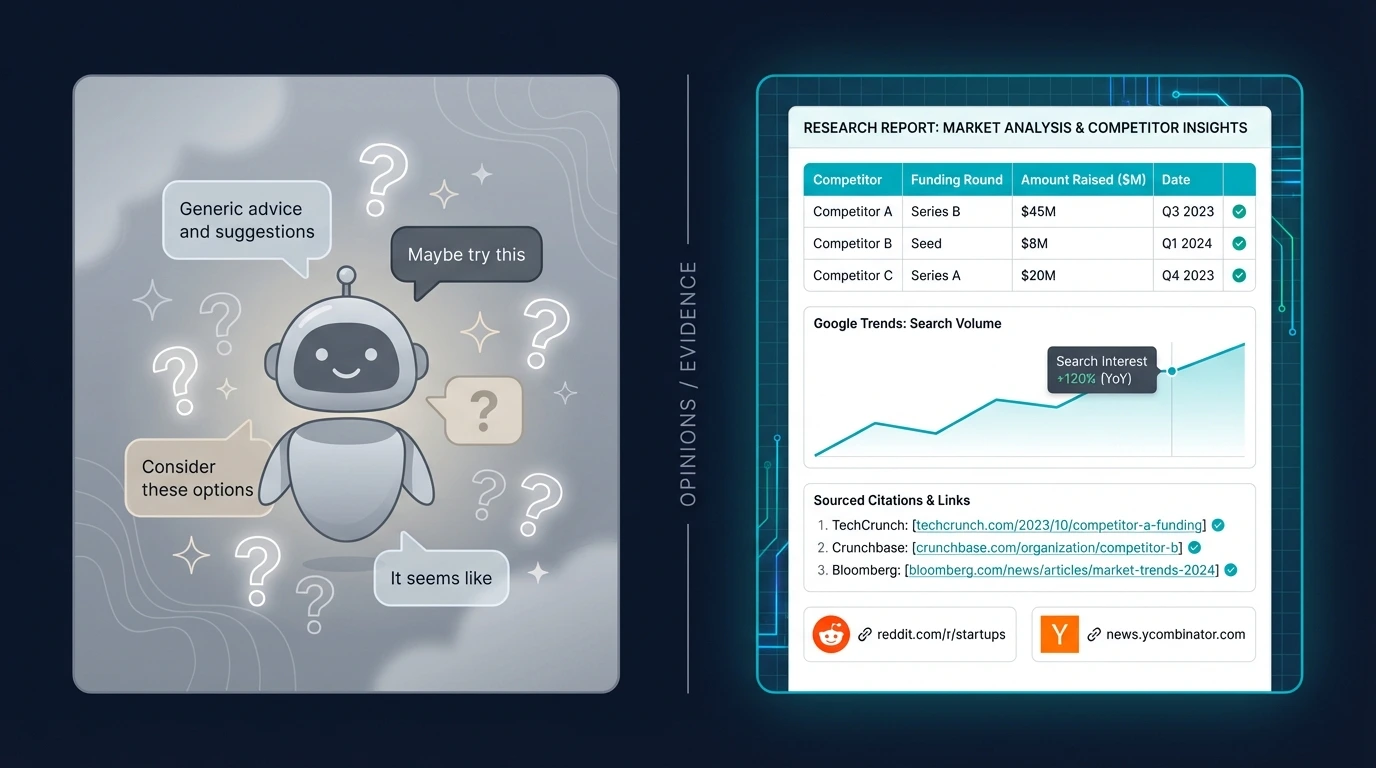
I built a tool that scans 20+ sources: competitors, search trends, Reddit discussions, market data. It scores your idea 0-100 and shows exactly what's strong and what needs work.
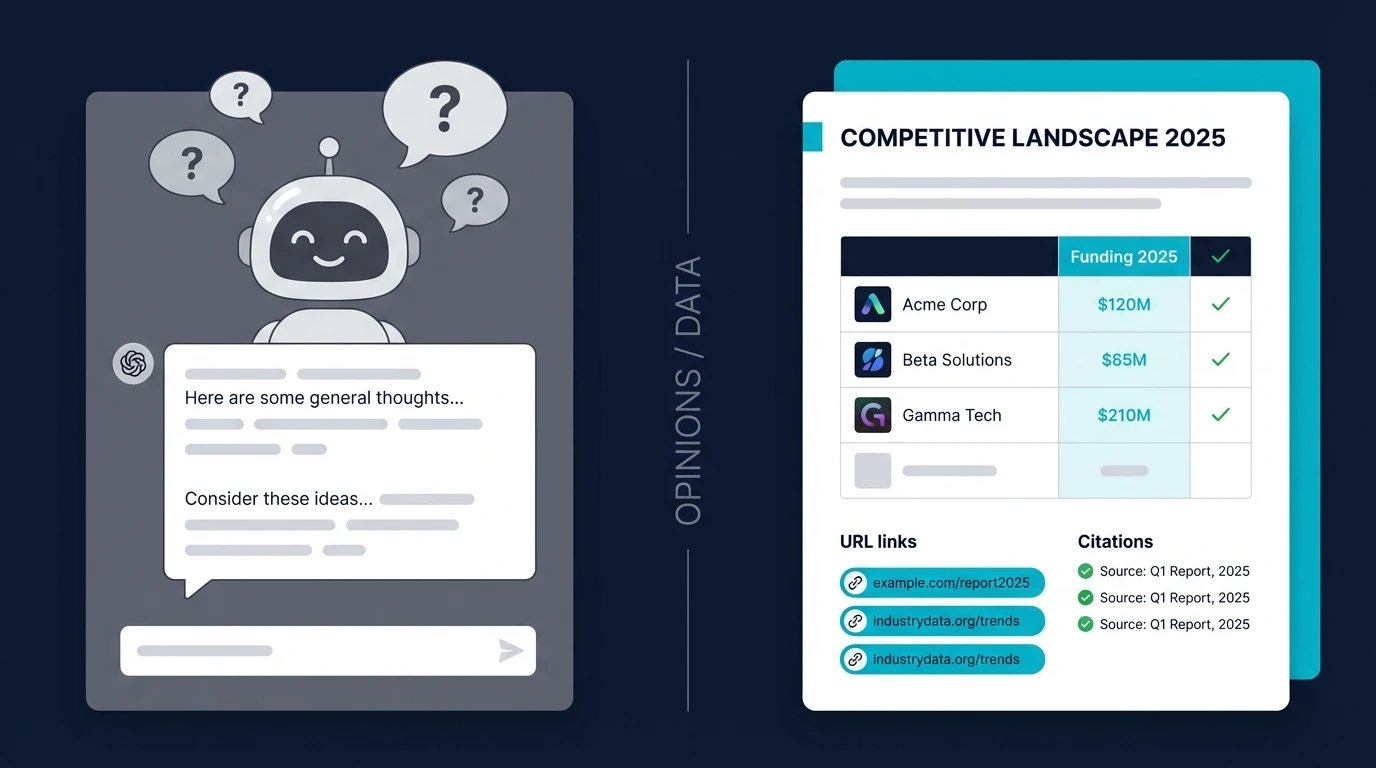
Not opinions. Not vibes. Data.
Red Flags That Kill Ideas
Even if your score looks good, these phrases should trigger alarm bells:
"Everyone needs this"
No they don't. When everyone is your customer, no one is. "Busy professionals" is meaningless. "Solo accountants with 10-50 clients" is a market you can actually reach.
"No one is doing this"
Someone is. Either directly or with spreadsheets and duct tape. If you truly can't find alternatives, the market probably doesn't exist. Or you stopped looking too early.
"I just need to build it and they'll come"
They won't. Distribution is harder than building. If you can't explain exactly how 100 customers will find you in the first 6 months, the idea isn't ready.
"It's like Uber for X"
Uber worked because of very specific conditions: smartphone adoption, GPS, payment infrastructure, regulatory arbitrage. "Uber for X" is usually code for "I haven't thought through the economics."
"I've been thinking about this for months"
Thinking isn't validation. Talking to customers is. The longer you think without testing, the more emotionally attached you get to a potentially bad idea.
What To Do Next
If your idea scores well:
- 1. Talk to 10 potential customers this week
- 2. Validate the specific pain points
- 3. Check competitor weaknesses
- 4. Build a landing page and test demand
If your idea scores poorly:
- 1. Identify what's weakest
- 2. Try repositioning (different angle, different customer)
- 3. If nothing moves the score, pick a new idea
Both paths are wins. You either validated a good idea or killed a bad one before wasting six months building something nobody wants.
Ready to go deeper? Read our complete SaaS validation framework for a weekend deep-dive.
Frequently Asked Questions
How do I know if my business idea is viable?
Three things: a real problem people will pay to solve, a market you can actually reach, and economics that don't require miracles. If any one of those is weak, fix it or find a new idea.
What makes a startup idea "good"?
Good ideas solve painful problems for specific people who will pay. They exist in markets with some competition (that's proof of demand) but clear gaps. And you have some edge: expertise, distribution, or timing. That's it.
Should I trust my gut?
On whether the idea is good? No. Your gut is biased toward ideas that excite you, not ideas that will work. Validate with data first. Then trust your gut on execution and product decisions.
How many competitors is too many?
50+ direct competitors with no clear differentiation is almost always too many. But 5-15 competitors with clear weaknesses? That's the sweet spot. Validated market, room to win.
Is my idea too simple?
Probably not. Simple is good. The best products solve one problem extremely well. If your idea feels too simple, that's usually a feature, not a bug. Complexity means you haven't figured out what actually matters yet.
How long should I spend validating?
One weekend for initial validation. If you can't get a clear signal in a weekend, either the idea is too vague or you're overthinking it. Move fast, test cheap, iterate or kill.
Get Your Score in 60 Seconds
Stop guessing. Start knowing. Our AI scans 20+ data sources to score your idea 0-100 and show exactly what's strong and what's weak.
Check Your Idea Now (Free)→